
Maxillary and Mandibular Expansion
There are many reasons why expansion of either the maxilla (upper jaw) or mandible (lower jaw) may be necessary or beneficial. Historically, this was performed for correction of malocclusions (bad bites) involving crowding of the teeth in the upper jaw. Many patients have been treated in their youth with a palatal expander that widened or “expanded” the upper jaw to create room for their teeth to be positioned correctly (Rapid Palatal Expansion or RPE). However, this procedure is more challenging in adult patients due to maturation of the bone and fusion of the mid-palatal suture. Due to this, adults often require surgery called Surgically Assisted Rapid Palatal Expansion or SARPE.
In recent years, the indications for expansion have increased to include management of upper airway resistance syndrome (UARS), Snoring, and Obstructive Sleep Apnea (OSA) with many patient’s OSA significantly improved or cured with expansion alone. With the increase in indications there have been many advances in the materials and techniques used in expansion of the jaws. Currently, expansion can often be obtained using custom appliances/expanders secured on the palate using mini-screws or Temporary Anchorage Devices (TADs) that allow the expansion to occur easier, often with minimal surgery and recovery, and minimal tilting of the teeth as was common in traditional devices. This procedure is often termed MSE when only the expander appliance and mini-screws are used and DOME when surgery is required. At Arizona Jaw Surgery, we also offer a hybrid method of minimally invasive surgery for Maxillary Expansion using minimal cuts and dissection that results in less pain, swelling, and morbidity compared to traditional DOME or SARPE.
Additionally, the use of mandibular (lower jaw) expansion is becoming more common in patients with severe dental crowding for orthodontic purposes or who have limited tongue space causing worsening of their Obstructive Sleep Apnea. Similarly to maxillary expansion, mandibular expansion requires the use of an expander appliance to create space between the teeth. However, mandibular expansion always requires surgery due to the increased density of the bone in the lower jaw.
Occasionally, both jaws are expanded to create more space for the dentition or to widen both jaws as a first-line treatment for OSA which is later followed by maxillomandibular advancement (MMA). However, this is often for more severe cases or for cases that specifically involve severely narrowed jaws.
Expansion of the jaws relies on a process known as Distraction Osteogenesis. This is a well established process that begins when bones are separated and allowed to heal for a short period of time before widening the separation (distracting) them with an appliance. The slow expansion allows the healing bone to create more bone across the gaps (osteogenesis) resulting in new bone formation along the space.
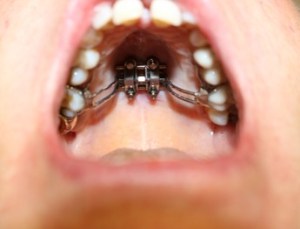
Image showing results of the DOME procedure using miniscrews inserted through an expander and the palate which cause bony separation and growth of new bone (distraction osteogenesis). Note the space between the front teeth (diastema) indicating successful expansion.
For information on costs associated with maxillary and/or mandibular expansion, visit our prices page.